
Reviewed by outbound sales practitioners | Updated for 2026 | Based on real B2B outbound data
Every cold email follow up you send is a small bet, and the question is whether the odds are with you or against you. Most reps quit at message two, and that is where the pipeline dies before it ever starts.
The math is stubborn. First-send reply rates in B2B cold outreach usually sit between two and five percent. But sequences that keep going, and keep going the right way, pull two to three times that number.
So the real question is not whether to keep sending. It is what to send, when to send it, and how to stop sounding like the person who was already ignored last Tuesday. And that is what we are going to unpack.
Why Cold Email Follow-Ups Need a Different Approach
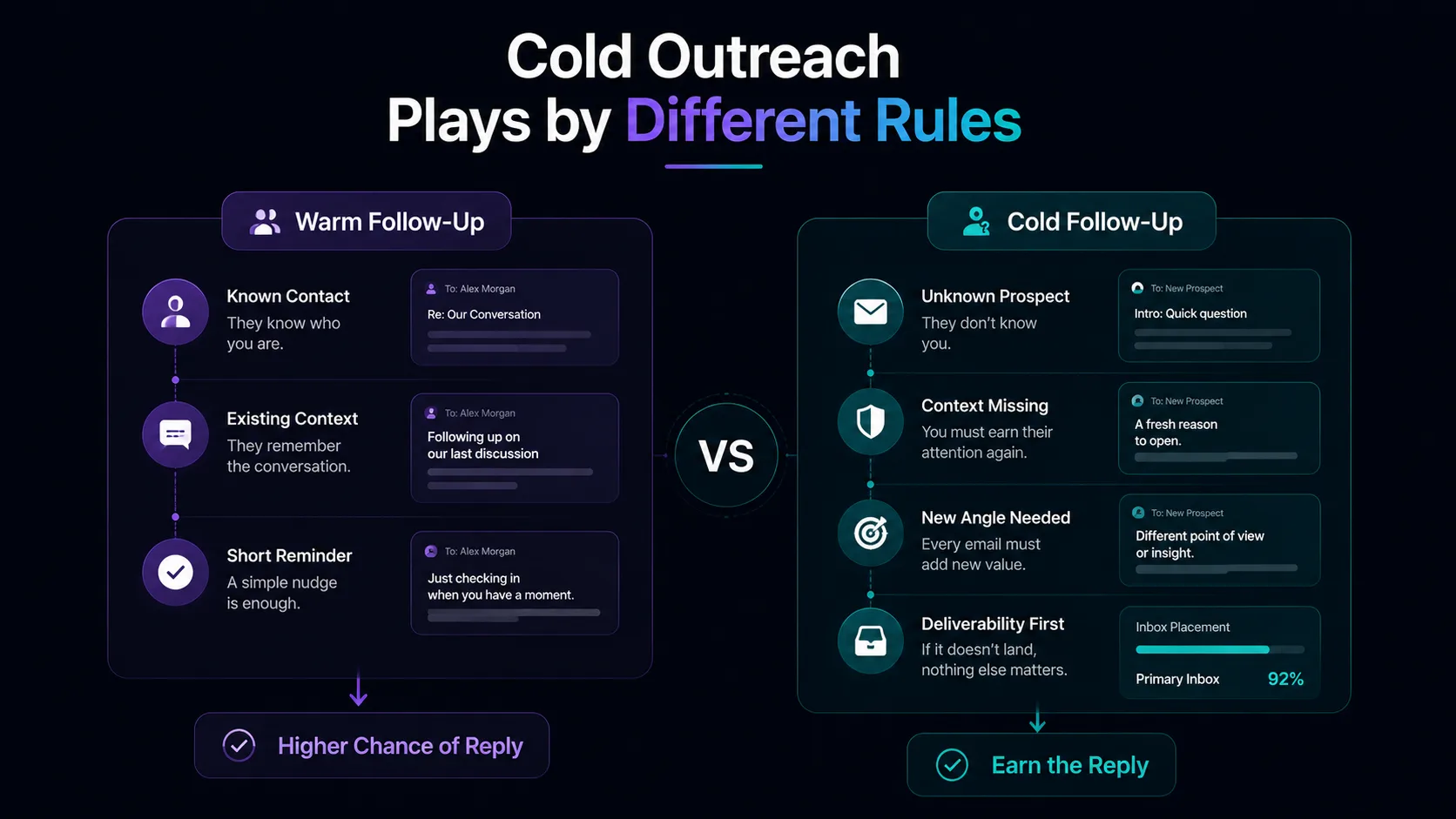
Warm follow-up and cold outreach follow up are not the same sport. A warm lead already knows who you are, and probably wants to hear back. But a cold prospect owes you nothing.
That difference changes everything. It changes tone, cadence, subject-line pressure, and what you actually put in the body. So copy-pasting a warm-lead nudge into a cold outreach cadence is how good reps end up in the spam folder.
Cold email deliverability is the first invisible wall. If your first email did not land in the primary inbox, the second one is a wasted send. And a poorly warmed sending domain quietly tanks a whole cold email follow up sequence before anyone even reads the copy.
The second wall is context. In warm follow-up, the prospect remembers you. But in cold outbound sales, they do not, and sales prospecting emails have to briefly re-earn their right to exist every time. So every follow up needs a fresh angle, not a passive-aggressive "bumping this up."
So the goal here is not to remind. It is to add. Every send should carry a new reason for the prospect to look, not the same reason with a different subject line. And that framing shift changes how the whole sequence is built.
How Many Follow-Ups a Cold Email Sequence Needs
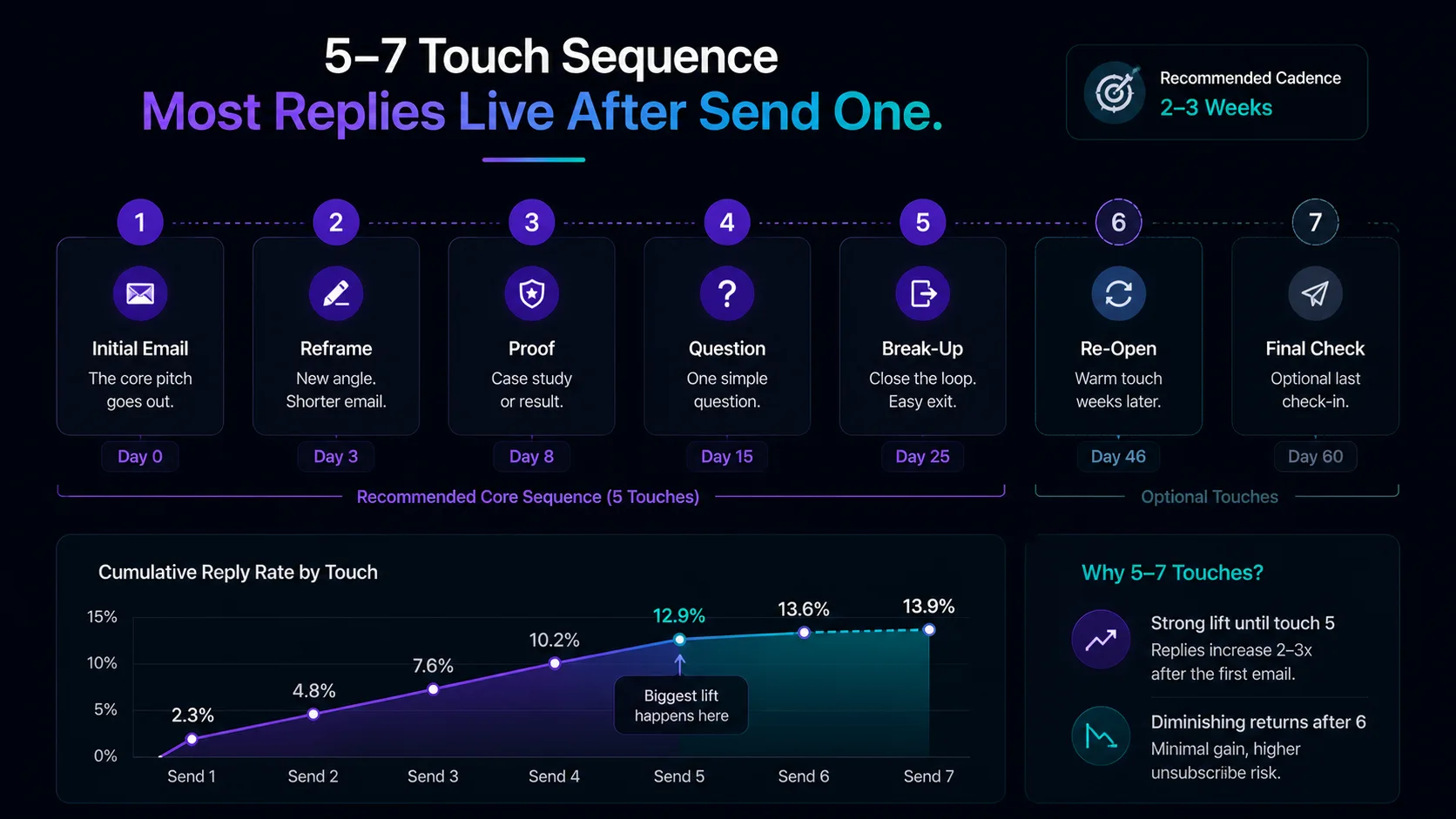
The short answer: five to seven touches, spaced across two to three weeks, is the sweet spot most teams settle on in 2026.
But the longer answer needs a caveat. Volume alone will not save a bad list, a weak subject line, or a pitch that solves no problem. However, when your first email is decent and your list is targeted, a well-built cold email follow up sequence outperforms one-and-done sending by a wide margin.
Here is the reasoning behind five to seven. Reply data across most B2B cold email programs shows a strong lift in cumulative response between the second and fifth send. But after the sixth or seventh, the lift flattens, and the unsubscribe rate quietly climbs.
Some industries can push higher because their buyers expect frequent touch. Others, like most regulated verticals, punish anything above five. So the right count is the one that respects both your buyer persona and your sending domain's reputation.
So the trap is not sending too few. The real trap is sending too many identical messages after the point where interest has already declared itself. That is not a cadence. That is noise, and a good cold outreach cadence knows when to stop as well as when to press.
Cold Email Follow-Up Timing
Timing is the second lever, and most people set it once and never test it again. But here is the pattern that has held up across our outbound sales tests in 2026.
The intent behind the schedule is simple. Give the inbox room to breathe between messages, but stay top-of-mind long enough that the prospect associates the problem you solve with your name.
Best Time of Day to Send a Cold Email Follow Up
Send times matter almost as much as send days. In our 2026 sample across B2B accounts, mid-morning local time consistently pulled the highest reply rate. Tuesday and Wednesday still lead. But Monday morning is now more crowded than it used to be, and Friday afternoons remain the graveyard shift.
Here is the current cadence framework we run in 2026:
| Touch | Days After Previous Send | Best Send Window (Local Time) | Angle Change |
|---|---|---|---|
| 1 (initial) | Day 0 | Tue/Wed, 9:30 to 11:00 AM | The core pitch |
| 2 | +3 days | Thu, 10:00 AM to 12:00 PM | New angle, shorter body |
| 3 | +5 days | Tue, 9:30 to 11:00 AM | Case study or proof |
| 4 | +7 days | Wed, 2:00 to 4:00 PM | Question-only, one line |
| 5 | +10 days | Tue, 10:00 AM | Break-up email |
| 6 (optional) | +21 days | Mon, 10:00 AM | Warm re-open |
The exact numbers will shift by industry. In fintech and cybersecurity, we compress the gap. But in education and healthcare procurement, we stretch it. However, the underlying cold email follow up strategy stays the same: fewer, better, more spaced apart.
What to Change in Each Follow-Up (Don't Just Repeat Yourself)
The single biggest reason cold outreach reply rates stay stuck is that follow-ups repeat the first email in slightly different words. The prospect already saw it. And they already ignored it. Sending it again with "circling back" glued to the top is not a follow up on cold email, but a mild annoyance.
Every touch in a multi-touch outreach sequence needs a distinct job. And if you cannot say in one sentence what a specific email is trying to do, cut it or rewrite it.
Here is how we usually rotate the angles:
- Send 2: Shorter than Send 1. Same problem, different framing. Often opens with the prospect's public activity, not with us.
- Send 3: Proof. A one-line customer result or a single relevant metric. Nothing else.
- Send 4: A single question. No pitch, no PS, no signature block gymnastics.
- Send 5: The break-up. Two lines, no guilt, easy exit. This one gets more replies than people expect.
- Send 6 (optional): The warm re-open, sent weeks later, referencing something specific that has changed on the prospect's side.
The reason this works is not clever copy. It is that each message earns its send because it says something the last one did not. So a cold email follow up that says nothing new is one the prospect can safely ignore.
Cold Email Follow-Up Examples
Real examples make this concrete faster than any framework. Here are three shortened versions of follow-ups from sequences we have shipped this year.
Example 1: Send 2, the shorter reframe
Subject: Quick thought on {trigger}

Saw {specific detail from their side}. It usually shows up when {problem} gets ahead of the team.

If it is on your list this quarter, we help teams like {peer company} handle it in about {timeframe}.

Worth ten minutes?
Example 2: Send 4, the one-question follow-up
Subject: One question

Is {specific outcome} something your team is working on in Q1, or is it parked for later in 2026?

Either answer is useful.
Example 3: Send 5, the break-up
Subject: Closing the loop

I do not want to keep filling your inbox. If this is not a priority right now, no problem, I will close the file. But if timing changes, my door is open.
These are shortened. The full cold email follow up template pack, including B2B versions for SDR, AE, and founder-led outbound, lives in our gated resource. Grab the full template set here.
Notice what none of them do. None of them apologize for following up. None of them say "just checking in." And none of them are longer than they need to be. That is not a stylistic choice, but the whole strategy.
Mistakes That Kill Cold Email Follow-Up Response Rates
Most broken cold email follow up strategy problems come down to a short list of repeat offenders. And we see the same ones across teams, from lead generation agencies to internal sales development orgs.
Sending too fast. Firing message two within twenty-four hours of message one signals automation, not attention. So give the inbox at least three days.
Passive-aggressive openers. "Did you get my last email?" and "Bumping this up" tell the prospect two things: you are keeping score, and you have nothing new to say.
Long paragraphs. A cold email follow up that reads like a landing page will be scrolled past on mobile before the first period. So keep it to short paragraphs, one idea per line.
Guessing at pain. Generic pain statements land generic replies, which usually means no reply. But specific triggers, like a hiring announcement, a funding round, or a product launch, do the heavy lifting.
Ignoring cold email response rate data. If you are not tracking reply rate per touch, you are guessing which send is dragging the sequence down. So instrument first, and rewrite second.
Wrong from-address hygiene. Cold email deliverability collapses fast on a domain with a bad sender score. So warm up new domains, use aliases, and check your DMARC and SPF once a quarter.
No exit ramp. Sequences that never end feel like harassment, not persistence. So end with a clean break-up email, and mean it. The prospect will remember the graceful exit if they ever come back to market.
Frequently Asked Questions
Conclusion
A good cold email follow up is a series of small, honest attempts to say something new to someone who has, so far, chosen not to reply. That is the whole game. So treat it like a craft, not a checklist.
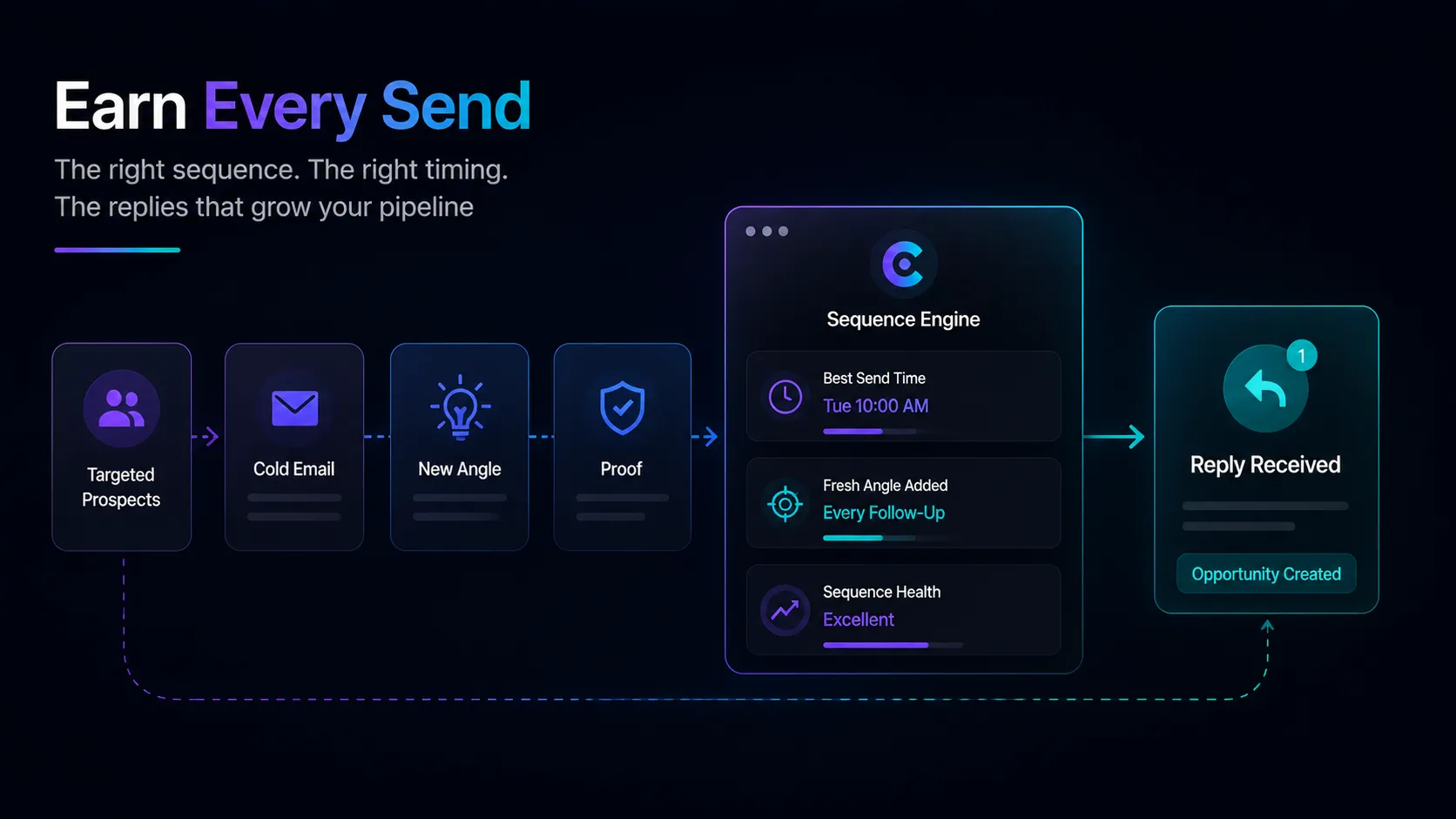
Build the sequence, respect the timing, change the angle, and cut the noise. In short, earn every send.
If you want the wider picture, our complete cold outreach pillar guide covers list building, targeting, and messaging strategy from the top down. And if inbox landing is your next bottleneck, Article 2 on cold email deliverability and sender warm-up is the one to read next.
The sequences that win in 2026 are not the loudest. But they are the ones where every follow up has earned the right to be there. And that is the standard we hold ourselves to for any team serious about building a program that pulls its weight in outbound sales.